
For a fixed listening desk, FiiO K11 Black is our best overall purchase among these three verified Malaysian offers. Its RM599 price buys a screen, external power and optical/coaxial inputs without the RM1,099 commitment of K7 BT. FiiO KA13 Black at RM369 is the budget and portable choice, while FiiO K7 BT is the specialist option for Bluetooth reception or an existing RCA line-level source. More expensive does not automatically mean audibly better with your headphones.
Prices and orderability were checked on 30 October 2026: LBS Music World listed the Black KA13 and Black K11 variants available at RM369 and RM599; MSL Digital’s exact With Bluetooth K7 BT variant was in stock and purchasable at RM1,099. These are device offers, not guaranteed Kuching delivered totals. This is an evidence-based specification and buying-workflow comparison, not a listening test, laboratory measurement or personal ownership report.
Choose the connections before the DAC chip
| Selected model | MY offer | Power arrangement | Headphone sockets | Source inputs | Practical control | Best fit |
|---|---|---|---|---|---|---|
| FiiO KA13 Black | RM369 | USB-powered dongle | 3.5mm / 4.4mm | USB-C | Side controls; app settings | Portable wired listening |
| FiiO K11 Black | RM599 | External DC12V 2A | 6.35mm / 4.4mm | USB / optical / coaxial | LCD; multifunction knob; 3 gains | Best overall desk value |
| FiiO K7 BT | RM1,099 | External 12V/24W supply | 6.35mm / 4.4mm | USB / optical / coaxial / RCA / Bluetooth | Large knob; 2 gains; input/output switching | Wireless and analogue-source integration |
FiiO KA13 Black: the lowest-cost option that can leave the desk
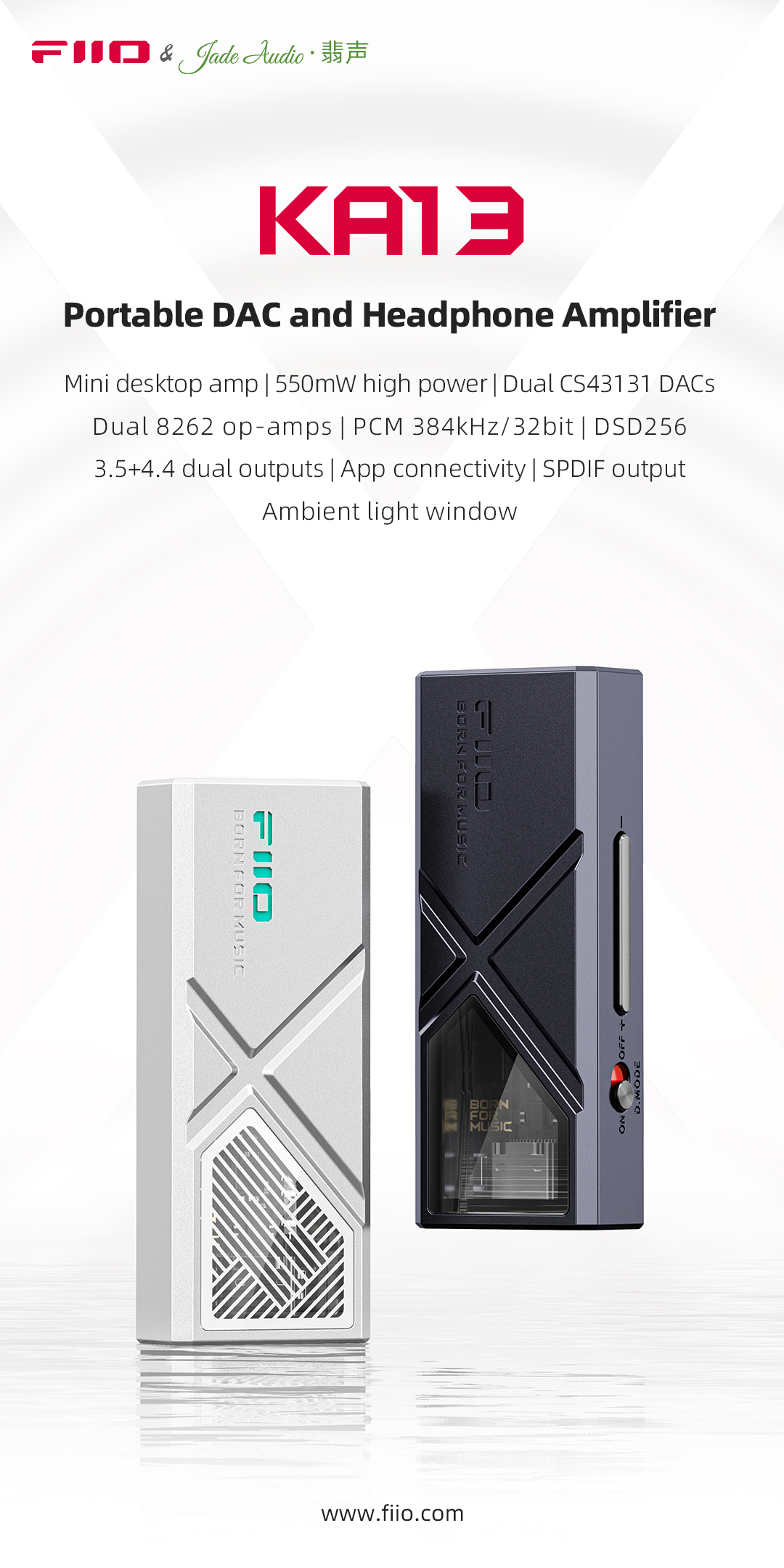
The KA13 is about 56.3 × 22 × 10.5mm and 18.5g excluding its cable. Dual CS43131 DACs, two SGM8262 op-amps and both 3.5mm single-ended and 4.4mm balanced sockets fit into that small body. USB-C is the digital input; a detachable cable is useful when moving between a laptop and a compatible phone. Check the cable and operating-system requirements of your actual device rather than assuming every USB-C socket sends audio.
Its desktop-mode balanced rating reaches 550mW per channel at 32Ω with THD+N below 1%; the corresponding published single-ended rating is 170mW per channel. Those are output specifications under stated conditions, not our measurements and not a claim that a sensitive IEM needs maximum power. The dongle draws power through USB, so portability comes with a source-battery and compatibility trade-off that externally powered K11 avoids. The desktop-mode name does not turn KA13 into an optical-input desktop unit.
Pros
- RM230 less than K11, with the only native 3.5mm headphone socket in this selection.
- Light enough to move with a phone or laptop; no separate desktop power brick in the listening chain.
- 4.4mm balanced output and configurable app functions without the price of a larger desktop box.
Cons
- No verified optical or coaxial source input; its supported SPDIF function is an output, not an input.
- No K11-style display or large desk volume knob.
- USB power demand and the cable hanging from a phone may be less convenient than wireless reception.
Buy KA13 if your headphones terminate in 3.5mm or 4.4mm and your source is USB. Avoid it for a TV’s optical output or an analogue turntable chain. A plug adapter cannot convert those signals into USB audio.
FiiO K11 Black: our overall desk recommendation
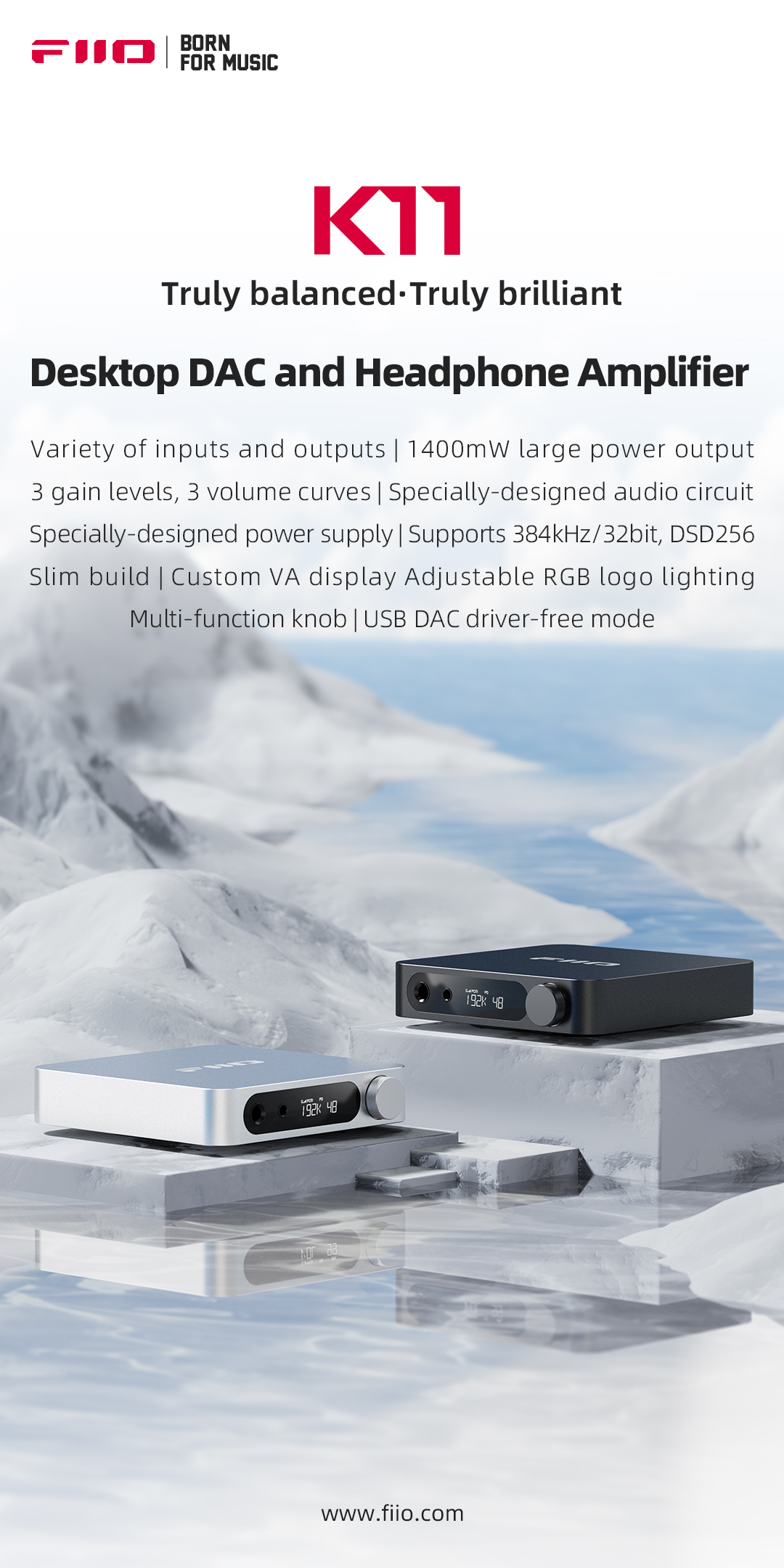
This is the original CS43198-based K11, not K11 R2R. The manufacturer specifies USB, optical and coaxial inputs; RCA line-out and 6.35mm/4.4mm headphone sockets make it easier to organise a fixed setup. The coaxial input and output share one physical connector, and coaxial output operates only in USB mode. Do not plan simultaneous connections as though those were two independent sockets.
The K11’s external DC12V 2A supply separates its power needs from a connected phone. Its screen shows volume, sample rate, gain or output mode, and the knob handles menu navigation as well as volume. Three gain levels each have a separate volume curve. These are useful everyday differences from KA13 when the unit sits beside a keyboard; they are a stronger reason to upgrade than reading a DAC-chip name as a sound-quality ranking.
FiiO rates balanced output at 1,400mW per channel into 32Ω at THD+N below 1% in high gain. One retailer headline incorrectly says 1,400 watts: the manufacturer figure is 1,400 milliwatts, or 1.4W per channel under that condition. Its 6.35mm output has a different rating, so a 3.5mm headphone connected through a simple size adapter does not receive the balanced-output specification. Start in low gain and at low volume.
Pros
- Only RM230 above KA13 for external power, a readable screen and more digital source inputs.
- 147 × 133 × 32.3mm including feet: a low-profile desktop footprint.
- RCA line-out supports an active-speaker or separate-amplifier workflow; three gain choices aid level matching.
Cons
- No verified Bluetooth reception or RCA analogue input in the original K11 specification.
- Needs its power adapter and a fixed location; it is not a pocket dongle.
- Menu functions share one knob, and a 3.5mm plug needs an appropriate 6.35mm size adapter for single-ended listening.
Choose K11 for a USB computer desk or compatible optical/coaxial source. Skip it if wireless phone playback is the whole reason for buying, or if you need to feed in an analogue line signal.
FiiO K7 BT: spend extra for a different source workflow
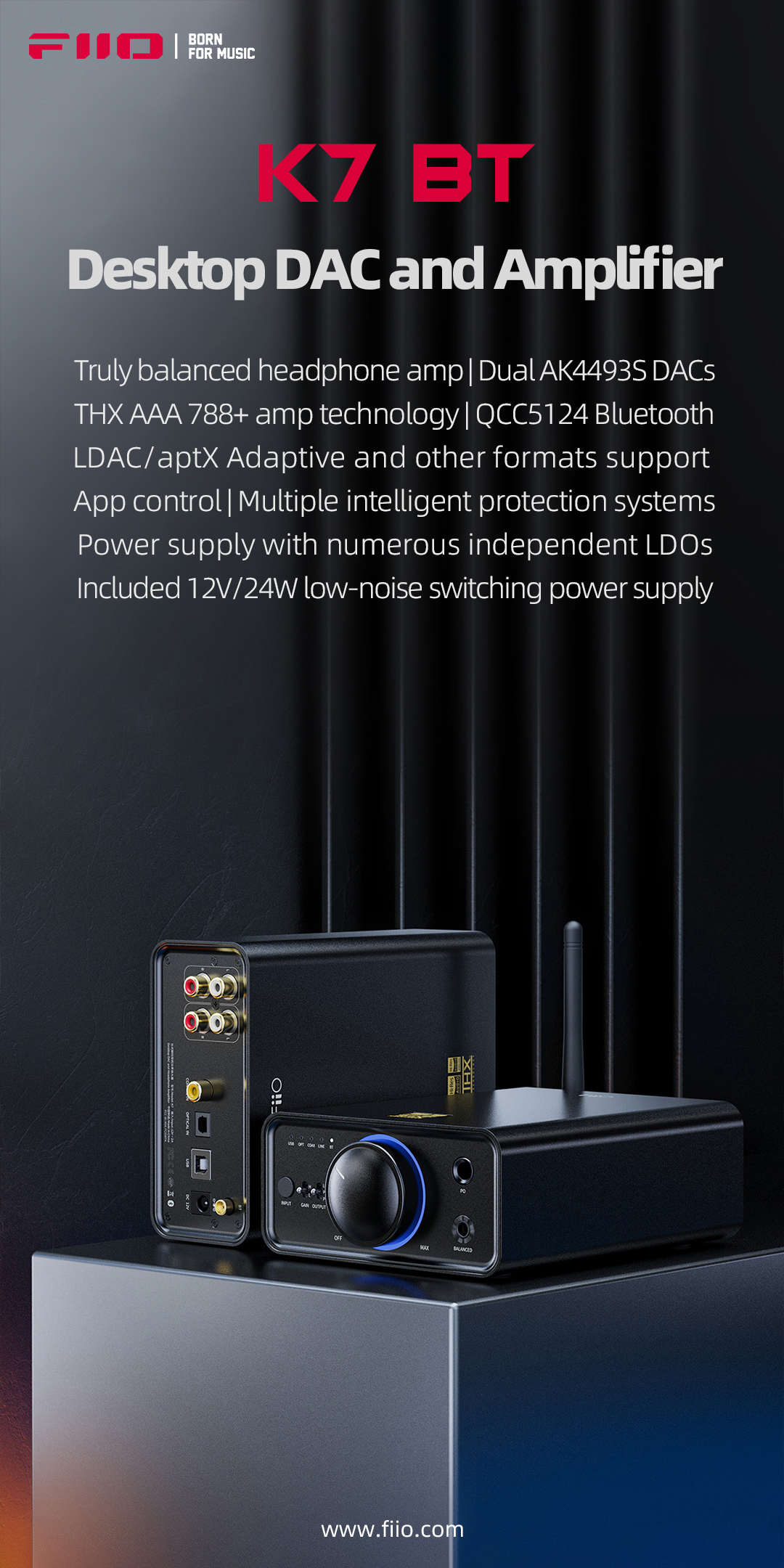
The K7 BT combines dual AK4493SEQ DACs and THX AAA 788+ amplification with a QCC5124 Bluetooth receiver. FiiO lists Bluetooth 5.1 and LDAC, aptX Adaptive, aptX HD, aptX LL, aptX, AAC and SBC support. The codec actually negotiated still depends on the sending phone or computer; owning a receiver with LDAC does not make every phone transmit LDAC. This is Bluetooth reception for a wired headphone setup, not a promise to transmit to wireless headphones.
Its RCA analogue line inputs distinguish it from K11. Together with USB, optical and coaxial inputs, RCA line outputs and the two headphone sockets, K7 BT can become a switching point for several sources. A turntable still needs a suitable phono stage before a line input; no phono preamplifier is established here. The verified unit is the BT version, identified by the retailer’s FIIOK7BT variant and its antenna, not an interchangeable listing for the cheaper non-Bluetooth K7.
The manufacturer’s shared K7/K7 BT page lists balanced output of at least 2,000mW into 32Ω at THD+N below 1%, plus high/low hardware gain. This supplies more stated output headroom than K11 at the same nominal load, but headphone sensitivity and your listening level matter more than chasing a wattage number. The 120 × 168 × 55mm, approximately 610g chassis and included 12V/24W supply belong on a desk, not hanging from a phone.
Pros
- Bluetooth reception adds a genuinely different way to feed the system.
- RCA line input can integrate an existing analogue source that the other two do not accept.
- Large volume dial, input switching and separate headphone/line-output modes suit a multi-device desk.
Cons
- RM500 above K11, without its price being proof of superior audible results.
- No K11-style numeric display, and the larger enclosure requires more vertical space.
- Wireless codecs, app functions and source compatibility require checking; Bluetooth is not universally lossless.
Buy K7 BT if you will actually use Bluetooth or RCA line input. Do not pay the premium merely for ordinary USB playback into easy-to-drive headphones.
Malaysia warranty, cabling and the final decision
MSL’s K7 BT page states a one-year official FiiO Malaysia warranty. LBS says its FiiO stock comes through the official Malaysian distributor with warranty support, but the captured model offers do not establish a duration for KA13 or K11; ask for that in writing. Confirm the invoice, exact colour/BT variant, included power adapter and cables, return terms, service location and who pays warranty freight from Sarawak. A live available flag is not an unconditional dispatch or delivery-date guarantee.
Balanced 4.4mm requires an appropriately wired headphone cable. Do not use a passive adapter that ties balanced amplifier outputs together. RCA line-out is not a direct power output for passive speakers. None of these models has a verified microphone-input function in this comparison; a gaming headset microphone may need a separate route. Check whether your television can send supported PCM over optical and check the exact computer/console requirements before ordering.
Our verdict stays with K11 Black at RM599 for a stationary desk: the display, external power and digital inputs justify the RM230 step from KA13. Choose KA13 Black at RM369 when mobility, 3.5mm access and lower cost matter most. Select K7 BT at RM1,099 only when Bluetooth reception or analogue line input earns the extra RM500. There is no need to buy an external DAC if the source you already own reaches clean, comfortable listening levels and you need none of these connection features.
Checked Malaysian offers and official specifications
- FiiO KA13 Black · RM369; checked 30 October 2026
- FiiO K11 Black · RM599; checked 30 October 2026
- FiiO K7 BT · RM1,099; checked 30 October 2026
- FiiO KA13 · FiiO K11 · FiiO K7 / K7 BT
Pingback: DAC Fon Kepala Malaysia: Pilih FiiO KA13, K11 atau K7 BT? - Eazy Picks
Pingback: 马来西亚耳机解码耳放怎么选?FiiO KA13、K11、K7 BT 价差与接口比较 - Eazy Picks